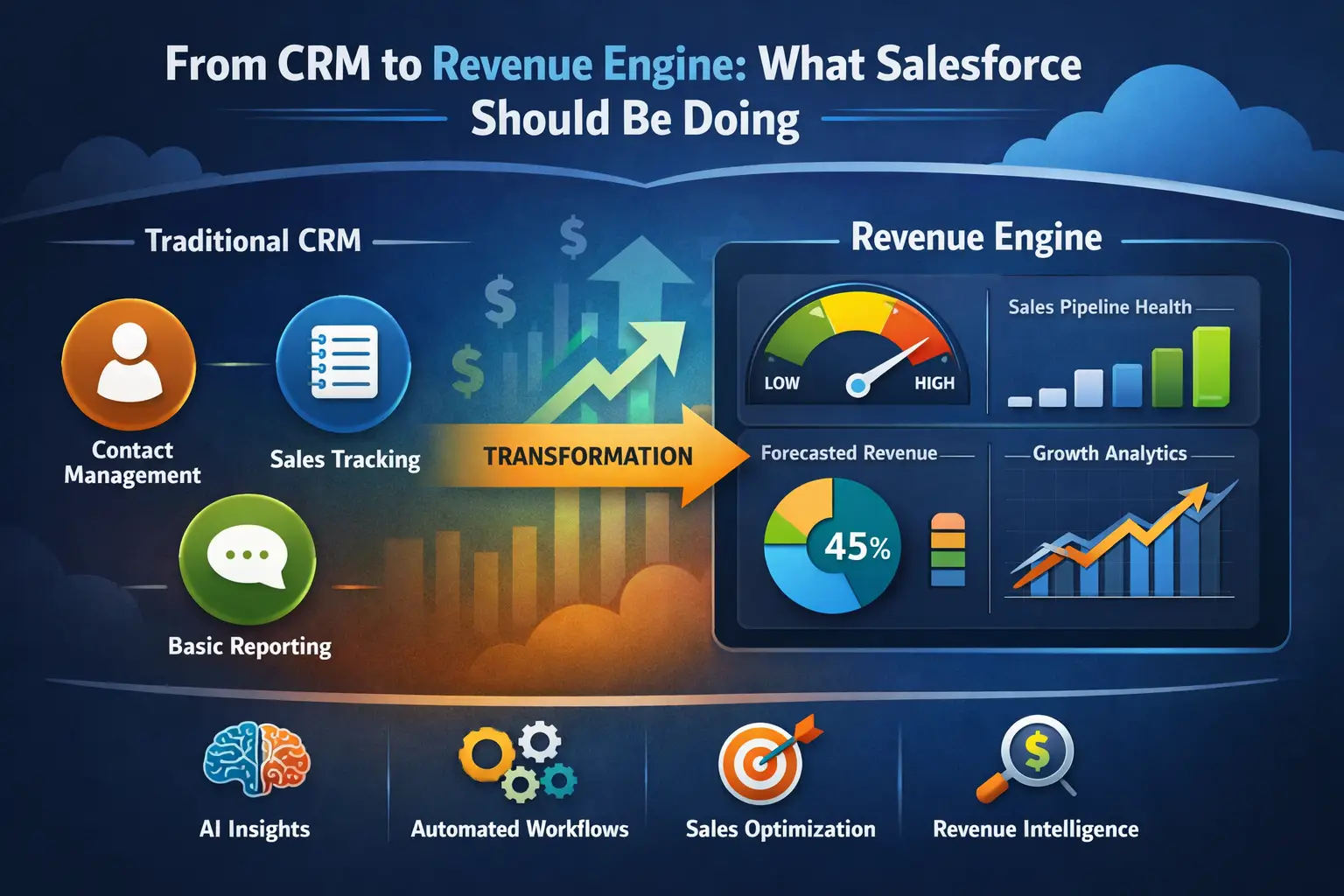
For most organizations, Salesforce exists.
It’s implemented.
It’s customized.
It’s populated with data.
And yet—revenue still feels harder than it should.
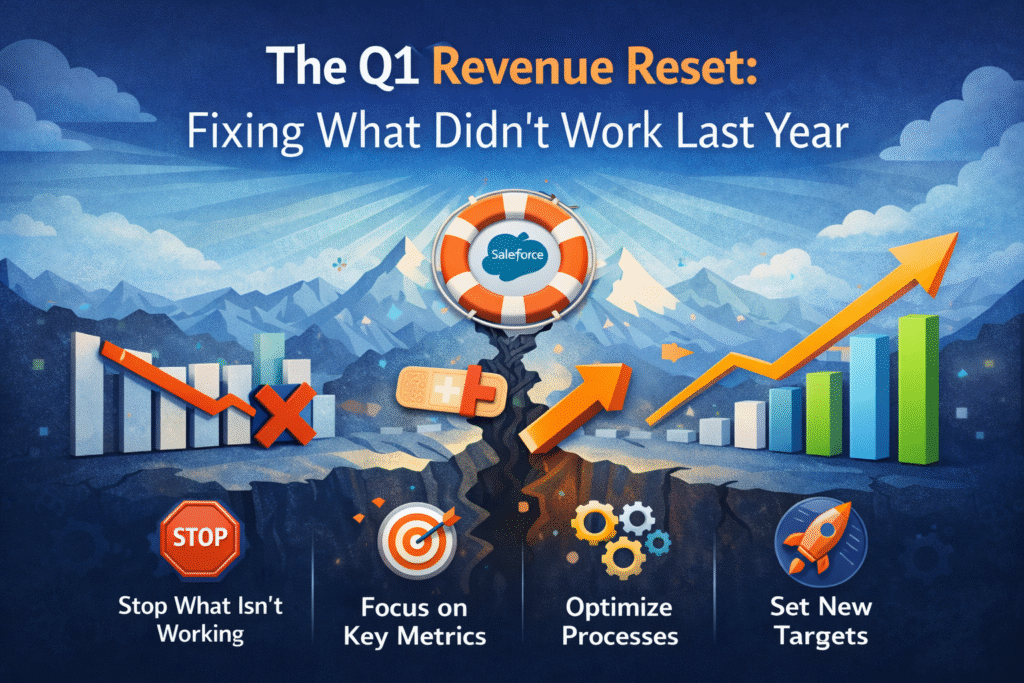
That’s because too many teams treat Salesforce like a system of record, not a system of growth.
A CRM that only stores information isn’t doing its job. Salesforce should be driving revenue, improving decisions, and creating momentum across the entire go-to-market motion.
Here’s what that actually looks like.
The Problem: Salesforce Is Stuck in “CRM Mode”
Most Salesforce orgs were built to track activity, not create outcomes.
You see it everywhere:
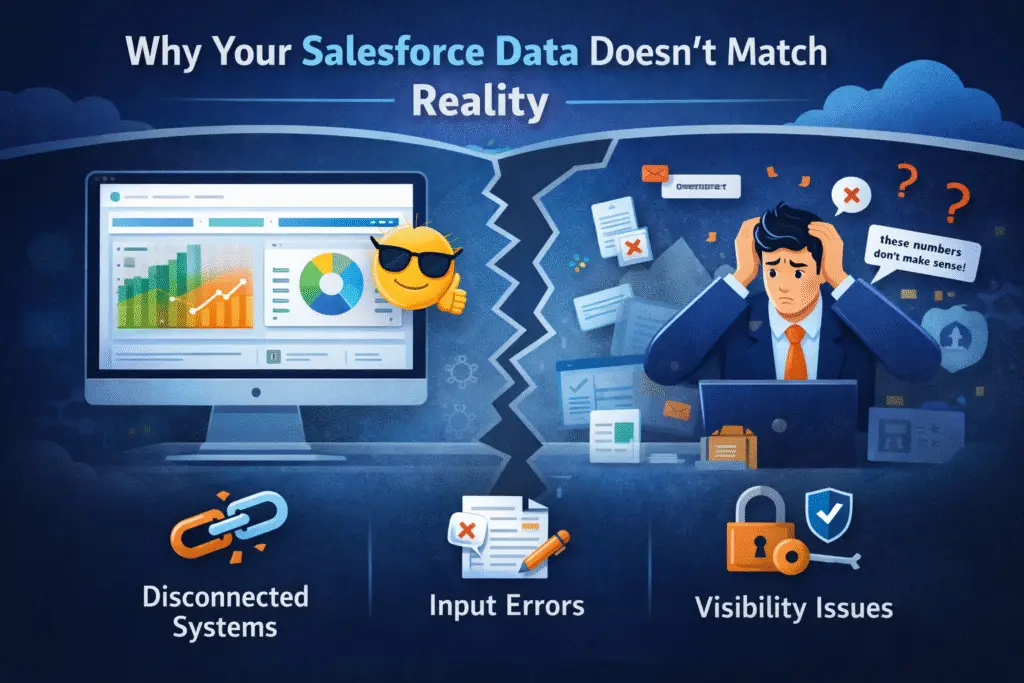
- Sales reps logging deals late (or not at all)
- Dashboards that look impressive but don’t change behavior
- Forecasts that feel more like guesses than signals
- Marketing, sales, and service operating in parallel—inside the same platform
The issue isn’t Salesforce.
It’s how Salesforce was designed, governed, and adopted.
When CRM strategy stops at “we need visibility,” revenue stalls.
What a Revenue Engine Actually Does
A revenue engine doesn’t just capture data. It shapes action.
When Salesforce is working the way it should, it:
- Guides reps toward the right deals at the right time
- Creates clarity around pipeline health—not vanity metrics
- Removes friction from selling instead of adding admin
- Aligns leadership around one version of reality
- Connects activity → pipeline → revenue → retention
In short: it helps teams make better decisions, faster.
1. Salesforce Should Be Designed Around Revenue Motion, Not Org Charts
Most Salesforce implementations mirror internal structure:
- Sales stages based on titles, not buyer behavior
- Fields added for every request, regardless of value
- Automation layered on top of broken processes
A revenue-first Salesforce org starts with one question:
How does money actually move through this business?
That means:
- Sales stages tied to buyer commitment, not internal steps
- Automation that accelerates momentum (not busywork)
- Data captured only when it drives a downstream decision
If Salesforce doesn’t reflect how revenue is created, it can’t help scale it.
2. Data Should Create Direction, Not Just Reports
Most teams have dashboards.
Very few have direction.
A true revenue engine uses data to answer:
- Where should reps focus this week?
- Which deals are real—and which are stalled?
- What leading indicators predict closed revenue?
- Where are we leaking pipeline?
If dashboards don’t change behavior, they’re decoration.
Salesforce should surface signals, not just summaries.
3. Adoption Is the Outcome of Good Design
You can’t train your way out of a bad system.
Low Salesforce adoption usually means:
- Too many required fields
- Too little value returned to the user
- Too much friction in core workflows
When Salesforce works as a revenue engine:
- Reps use it because it helps them win
- Leaders trust it because it reflects reality
- Teams align around it because it creates clarity
Adoption isn’t a people problem.
It’s a design problem.
4. Revenue Lives Across the Entire Customer Lifecycle
Revenue doesn’t stop at “Closed Won.”
A revenue engine connects:
- Marketing signals → sales prioritization
- Sales commitments → delivery expectations
- Customer outcomes → expansion opportunities
When Salesforce is siloed by function, revenue gets fragmented.
When Salesforce is unified, revenue compounds.
The Shift That Matters Most
Moving from CRM to revenue engine requires a mindset shift:
Salesforce is not a tool to manage people.
It’s a system to manage decisions.
That shift changes everything—from architecture to automation to analytics.
And it’s where most Salesforce projects fall short.
Final Thought
If Salesforce feels heavy, slow, or underwhelming, it’s not because you need more features.
It’s because Salesforce was never designed to be a revenue engine in the first place.
At Mercury Collective, we help teams rebuild Salesforce around how revenue actually happens—so the platform works for the business, not the other way around.
Because Salesforce shouldn’t just tell you what happened.
It should help you decide what to do next.