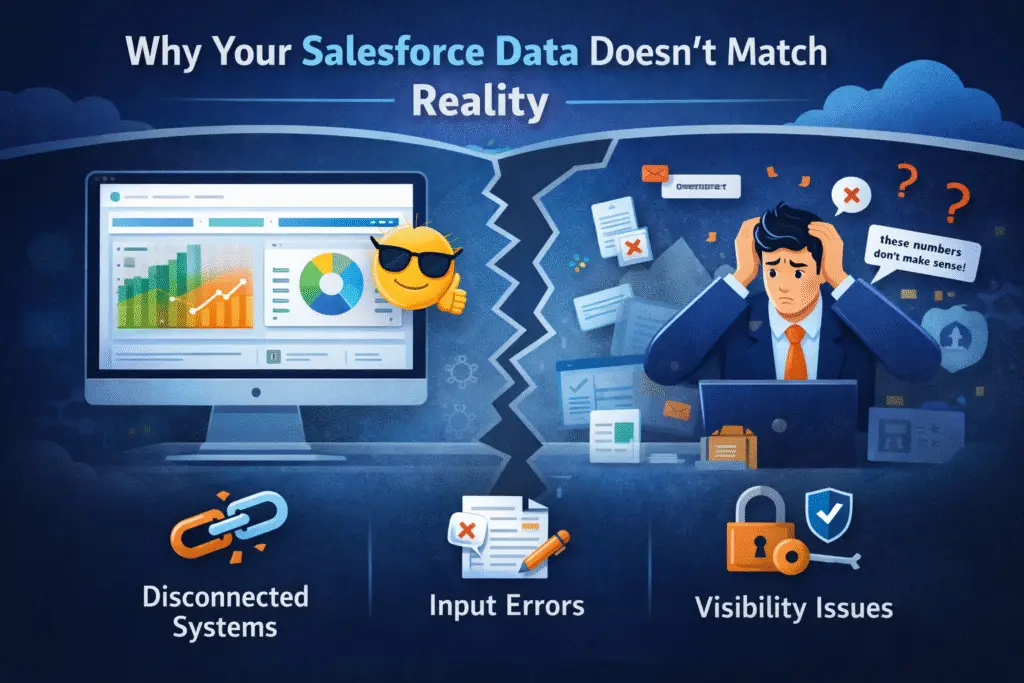
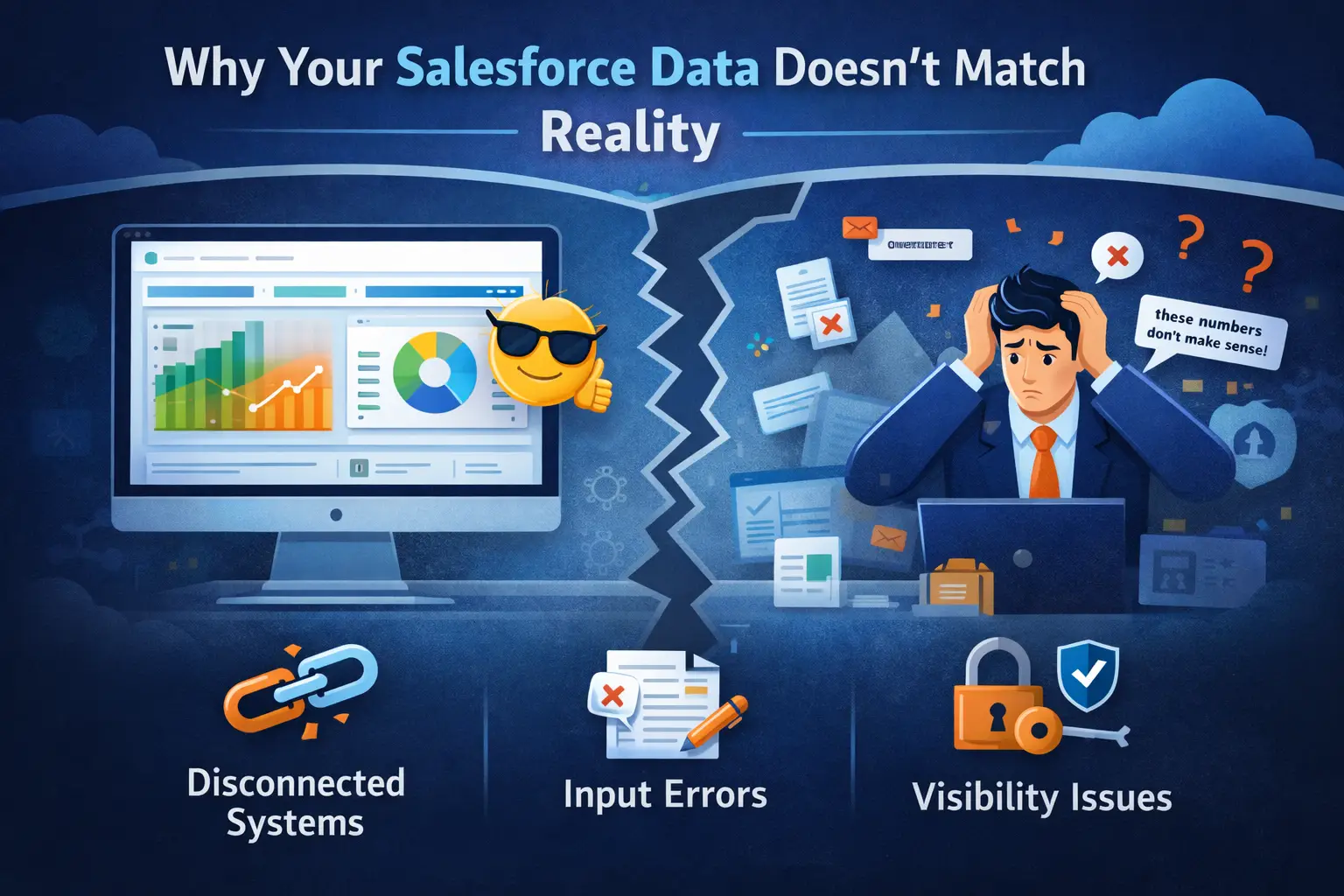
Your Salesforce dashboard says one thing.
Your sales team says another.
And your forecast? Somewhere in between.
If Salesforce feels technically accurate but operationally wrong, you’re not alone.
Most teams don’t have a data problem.
They have a reality problem.
And Salesforce is simply reflecting it.
The Illusion of “Clean” Data
On paper, everything looks fine:
- Required fields are filled in
- Stages are progressing
- Dashboards are populated
- Reports refresh on schedule
Yet leadership still asks:
- “Can we trust this pipeline?”
- “Which deals are actually real?”
- “Why do numbers change at the last minute?”
Because Salesforce data is only as accurate as the behaviors behind it.
And most systems reward the wrong ones.
1. Salesforce Is Optimized for Reporting, Not Truth
Many Salesforce orgs are designed to satisfy leadership reporting needs first.
That leads to:
- Overloaded fields reps fill out after deals move
- Stages updated retroactively to “look right”
- Forecasts shaped by expectations instead of evidence
When Salesforce becomes a reporting tool instead of a decision tool, data turns performative.
It looks right.
It isn’t real.
2. Sales Stages Don’t Reflect Buyer Behavior
This is one of the biggest disconnects.
If your sales stages are based on internal steps instead of buyer commitment, your data will always drift from reality.
Common symptoms:
- Deals sitting in late stages with no buyer action
- “Next steps” that aren’t owned by the customer
- Stage progression driven by optimism, not proof
When stages don’t match how buyers actually buy, Salesforce can’t tell the truth—even when reps try.
3. Data Entry Happens Too Late (or Under Pressure)
Most Salesforce updates happen:
- Right before forecast calls
- Right before quarter-end
- Right after leadership asks questions
That timing matters.
Late updates lead to:
- Inflated pipeline
- Compressed stage durations
- Surprise losses that “came out of nowhere”
Reality doesn’t change overnight.
Data just finally caught up.
4. Reps Don’t See Personal Value in the Data
If Salesforce only benefits leadership, reps will treat it like paperwork.
That results in:
- Minimal compliance
- Fields filled just enough to move on
- Notes that say nothing useful
When Salesforce doesn’t help reps prioritize, qualify, or close deals, accuracy becomes optional.
Bad data isn’t malicious.
It’s rational.
5. Forecasting Is Built on Lagging Indicators
Many forecasts rely on:
- Stage name
- Close date
- Deal size
None of those predict reality.
What actually matters:
- Buyer engagement
- Mutual action plans
- Time since last meaningful activity
- Deal momentum (or lack of it)
If Salesforce isn’t tracking leading indicators, your forecast will always feel disconnected from the real world.
The Real Issue: Salesforce Reflects Incentives, Not Intent
Salesforce shows you what the system encourages—not what leadership hopes for.
If the system rewards:
- Speed over qualification
- Activity over outcomes
- Optimism over evidence
Then the data will follow.
Fix the incentives.
Reality follows.
How to Bring Salesforce Back to Reality
This isn’t about more fields or stricter rules.
It’s about alignment:
- Redesign stages around buyer action
- Capture data at the moment decisions happen
- Surface insights that help reps win
- Build dashboards that guide action, not explain the past
When Salesforce is aligned to how revenue actually moves, the data starts telling the truth.
Final Thought
If your Salesforce data doesn’t match reality, Salesforce isn’t broken.
It’s just honest about how your system is designed.
At Mercury Collective, we help teams rebuild Salesforce to reflect real buyer behavior, real momentum, and real revenue—so leadership can trust the data again.
Because clarity doesn’t come from cleaner data.
It comes from better design.